Is Marbella a good property investment in 2026?

After almost five boom years, is there still growth left in the Marbella property market and does it still make for a good investment?
Though people have been hesitant to use the word ‘boom’ it is fair to say that the past five years, following the end of the Covid Pandemic, have been buoyant in Marbella, producing some of the most impressive sales figures ever seen, especially when measured in revenue terms. The market has clearly moved upwards since the boom years of the 2000s, with record transaction values more than offsetting a slightly lower number of properties sold. This is not just due to inflation and higher prices in general but is also down to the fact that the apartments and villas being sold now are more luxurious, hence more expensive.

Marbella’s property market has therefore moved from mid-high to mostly just high-end, with outer municipalities such as Estepona, Ojén and Mijas also scaling upwards from mid to mid-high. This process can be mainly attributed to the lack of building land within Marbella and the scarcity this creates, a situation further contributed to by the city’s continued building licence delays. These factors have worked together to limit supply and keep high-end demand largely concentrated here with prices rising strongly. In spite of much of the new development that has taken place in recent years actually being focused on locations such as Estepona and Mijas, Marbella remains the international reference point for the entire Costa del Sol.
Recent track record
Over the past five years since the end of the Covid restrictions, Marbella has maybe not registered the most new properties constructed (for the reasons mentioned above), but it has continued to record the highest number of property transactions, the fastest rate of increase in property values and generally speaking the highest average selling price per property, though the relatively low sales volumes in neighbouring Benahavis and the very high values of the villas sold within its luxurious La Zagaleta, can sometimes skew the figures in its favour.

The Marbella property market therefore offers a high degree of security, with strong demand and limited supply, combined with property values that increase but seldom drop within most of its municipal boundaries. These include such top areas such as the Golden Mile, Sierra Blanca, Cascada de Camoján, El Madroñal, Nueva Andalucía, Puerto Banús, Guadalmina and Los Monteros – the areas that drive international demand and with it, growth. Marbella therefore continues to be the motor of the local property sector, adding a large number of refurbishment projects to the construction work being done along the coast.
Continued growth?
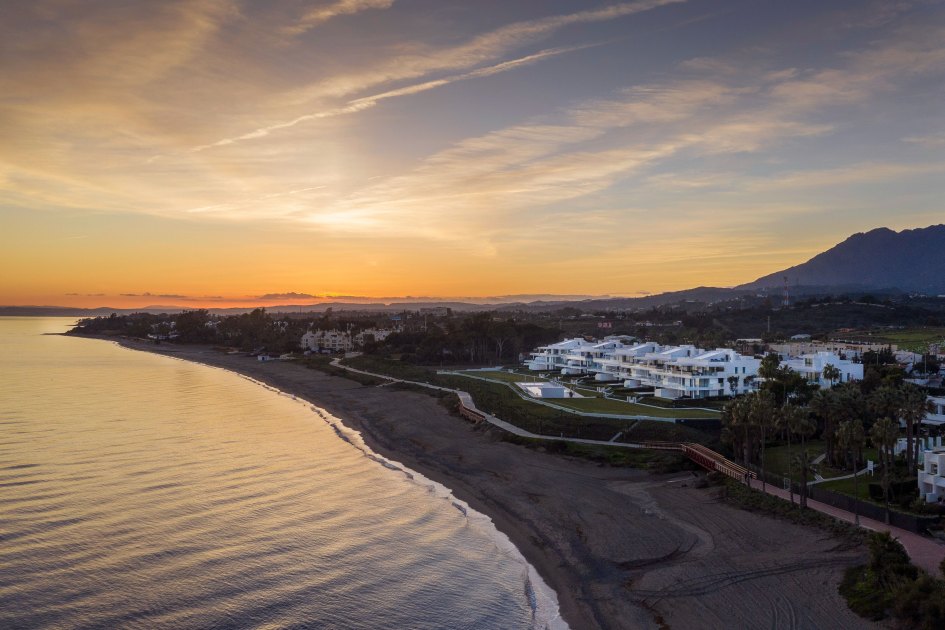
The question being asked now is if Marbella will continue to produce such results, given the very high level of activity that has been maintained over the past few years.
According to official Notaries’ statistics, residential sales across the Golden Triangle of Marbella, Estepona and Benahavís increased by 1.2% in 2025 compared with the previous year. This came after the record-breaking peak of 2022, when all three municipalities reached their highest sales volumes of the period. Since then, transaction levels have remained robust. In 2025, activity held firm overall. Even so, the last quarter of 2025 showed a slight slowdown in sales figures, price increases and also selling speeds.
Though it will have to be seen if this will continue into 2026, there is a general expectation that the market will cool off a little in the coming year, following the trend of the past few years. This would suggest business as usual but at a slightly lower rate of growth, accompanied by prices that will begin to rise more slowly – and in some residential areas will even stabilise. This is also true of the new build projects whose buyers have until now been able to absorb rather steep increases. There are indications that some of the new projects will begin to experience some price resistance, as is the case with resales.
Property prices grew by an average of 7,68% over 2025 [source: Notaries], a figure that is expected to be somewhat lower in 2026, albeit with variations. Resales are for instance expected to show slower price growth than newly built homes, while the upper segment of the market looks set to outpace the broader segment, where price is slowly becoming a factor in terms of both what people can afford and are willing to pay. For this reason, a degree of price and market cooling may be positive for the industry and allow value for money to recalibrate in favour of the buyer again, which can only be a good thing.
Marbella compared to nearby towns

Given the level of construction and transaction activity over the past few years it is tempting to say that towns such as Estepona, Mijas and Benahavís are the drivers of the local property market. Yet, while they have certainly contributed greatly, many might be surprised to hear that it is still Marbella that produces the greatest share of property sales. In 2025, Marbella accounted for just over 51% of all transactions within the Golden Triangle. In revenue terms, its lead is even more pronounced given its higher average price per square metre. Taken into perspective, one could say that Marbella represents the mature, well-established market of the Golden Triangle, while Estepona and Benahavís are the younger, emerging areas with a great deal of raw potential in terms of property sales, the supply of stylish new homes and lifestyle amenities, as well as the capital appreciation.
Marbella vs Balearic Islands

Marbella stands out compared to the Balearic Islands as a luxury real estate market, offering clear advantages for international investors and buyers. Unlike the Balearics, which maintain very high and restrictive prices, Marbella provides luxury and high-end properties with greater investment flexibility. Nearby municipalities such as Estepona and Mijas allow for new developments, something impossible on the islands where land scarcity constantly pressures the market. The area attracts a diversified international clientele from Europe, the Middle East, and the US, ensuring liquidity and stability against economic fluctuations. Year-round tourism appeal and relative land scarcity create a strong balance between rental yield and capital appreciation, while Marbella’s complete lifestyle offering—including premium services, international schools, and active leisure throughout the year—makes it far more than just a second-home destination.
Marbella Compared to other Destinations

Marbella continues to stand out among international lifestyle destinations, but its appeal now rests as much on stability as on lifestyle. In a market shaped by the war in Iran and broader geopolitical tension, buyers are placing greater value on safe, established locations. That plays to Marbella’s strengths: a mature prime market, a resilient mix of international buyers, year-round appeal, and a level of scarcity that underpins long-term value in a way many competing resort destinations cannot match, including Dubai under present circumstances.
Apart from Dubai, Marbella has been perhaps the number one draw among international lifestyle destinations over the past decade or so, outperforming similar resort areas across Europe and North America or the Caribbean. Many of those either remain niche markets, such as the Caribbean or the Costa Smeralda in Sardinia, have become too expensive and don’t have the same weather – such as Miami and the French and Italian Rivieras – or are not as high-end, such as the Costa Blanca, the Canary Islands and the Algarve.
In relation to the last three, Marbella offers more prestige and a higher standard of amenities, though at a higher price. These somewhat cheaper destinations will provide lower entry prices and higher rental yields though Marbella wins on capital appreciation. In the case of the Côte d’Azur, Marbella still offers better value per square metre, with a similar lifestyle and a better climate. Leaving niche markets aside, the Golden Triangle also compares favourably with for instance Florida when it comes to price, climate and also safety/security.
In conclusion, Marbella is a stable market where strong demand over limited supply ensures strong price growth and a loyal market base. This means the town is not likely to relinquish its pole position any time soon, especially when its urban planning issues are finally resolved and a large hitherto untapped reserve of potential building land is released back into the market. For this reason and the ongoing desirability of the lifestyle, setting and amenities it offers, Marbella does indeed continue to be a good property investment in 2026 as before.
Pia Arrieta, 26 Mar 2026 - News
Related Articles

Buying Property in Marbella: Legal Guide for Foreign Buyers
14 min. read · Pia Arrieta

DM Properties supports Casa Ronald Málaga through its Charity Golf Tournament
2 min. read · Pia Arrieta

Andalusia Tax Reform 2026- What Property Investors Should Know
2 min. read · Pia Arrieta

Sustainability in Spanish housing: how important is it?
9 min. read · Pia Arrieta